



Trip Duration
13 Days
Group Sizes
1-16 People
Transportation
Land Transportation
Destination
Nepal
Max. Altitude
4,130m. / 13,550ft.
Activities
- Trekking

Difficulty
Difficult
Meals
- 12 Breakfast
- 11 Lunch
- 11 Dinner

Accommodation
- Hotel
- Guest House
Trip Highlights
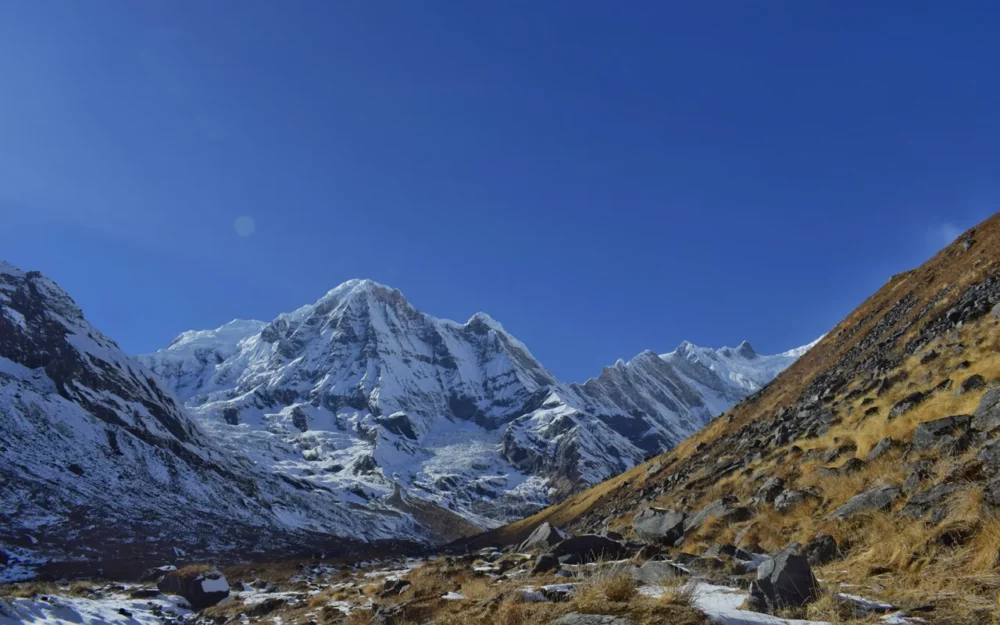
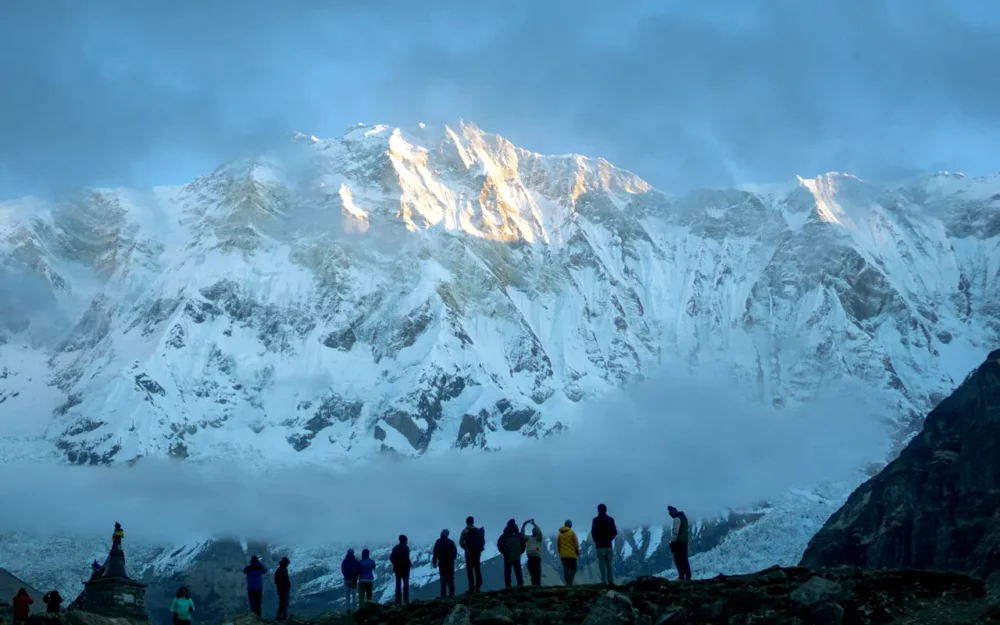
- Witness the Annapurna range to the majestic extent of the 10th highest peak in the world, Annapurna I (8,091m).
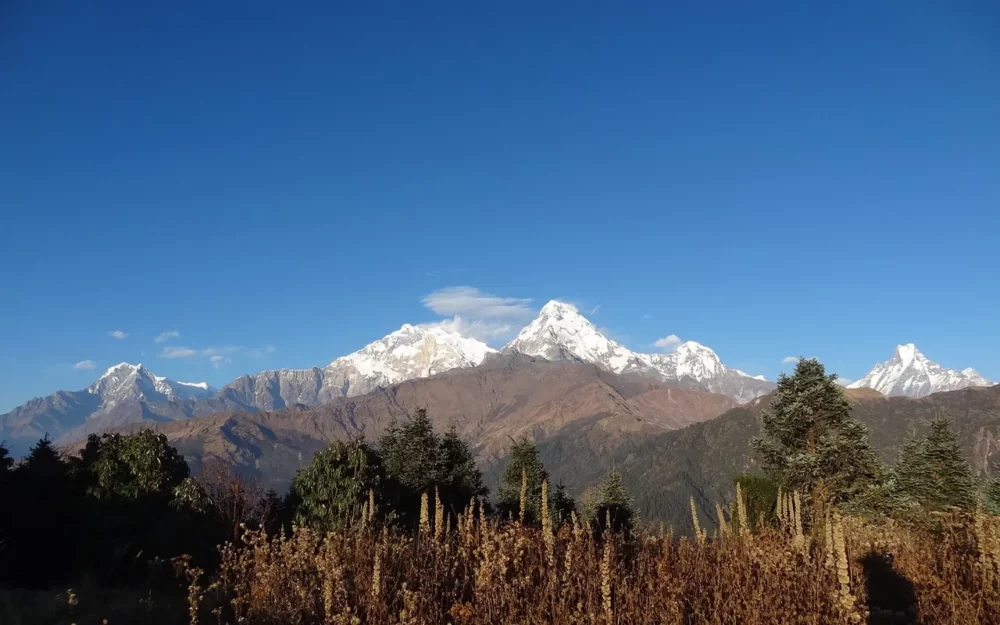
- See some of the tallest peaks such Dhaulagiri, Machhapuchhre, and Annapurna from Poon Hill.
- Trek through rhododendron forests, bamboo forests, high altitude landscapes filled with Himalayan flora and fauna.
- Mingle with the traditional Gurung and Magar villages, with usual encounters of hospitality, food and cultural heritage.
- Relax in Jhinu Danda, a perfect place to relax in the natural hot springs and soothe your muscles after long trekking days.
- Shoot surreal landscapes, like land in terraces, moraines of glaciers and majestic mountains shrouded in snow.
- Walk alongside waterfalls and a cascade of rivers, for instance, the Modi Khola fed from the glacial water.
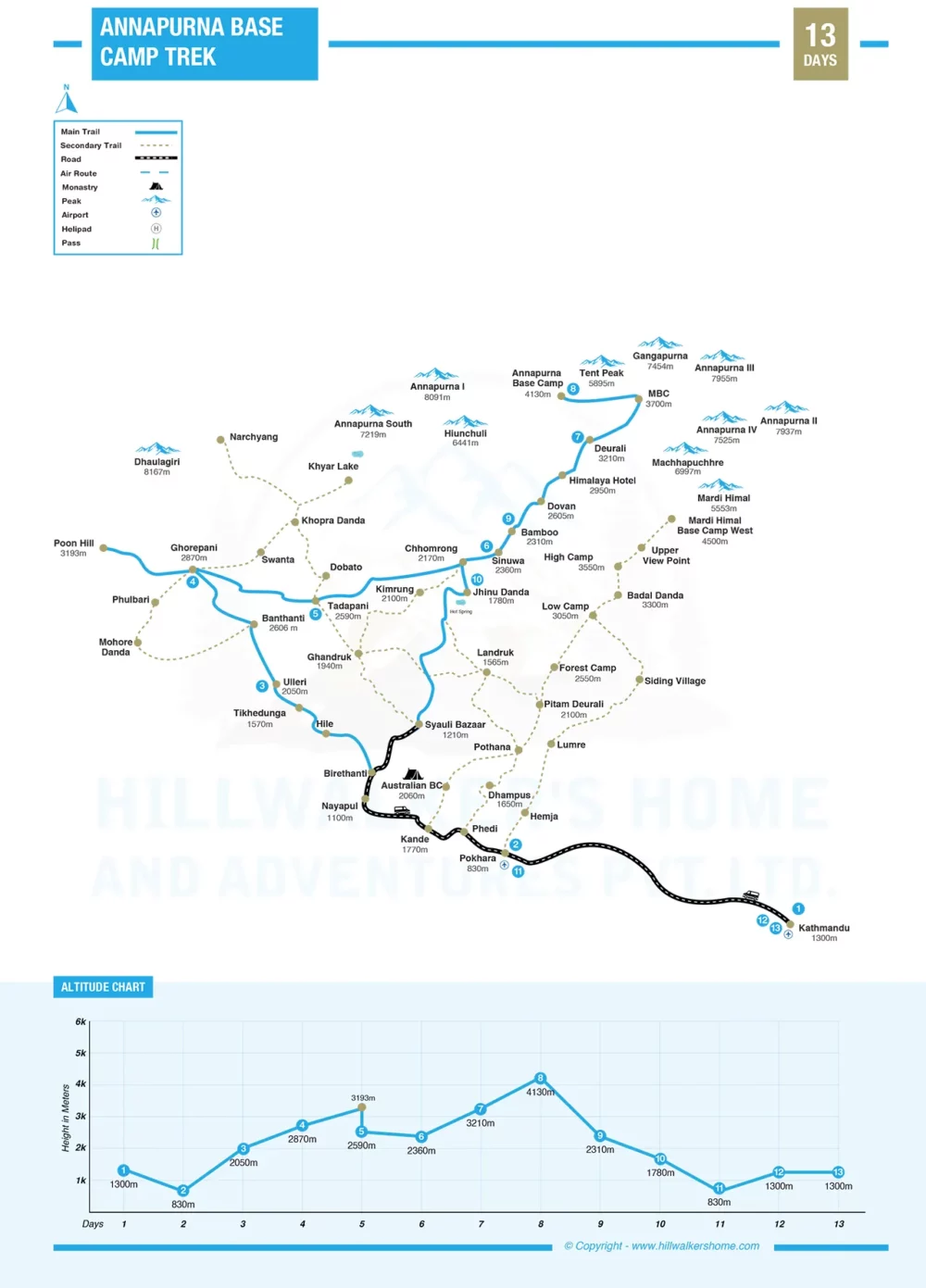
Overview of Annapurna Base Camp Trek | 13 Days
Annapurna Base Camp Trek is one of the most iconic trekking adventures in Nepal, for it has everything to offer for one time of trekking in Nepal: natural beauty, cultural richness and a moderate challenge.
This trek travels through a varying range of beautiful landscape, starting out of its well terraced rice fields, passing through subtropical forests to alpine meadows and into glacial basins in the heart of Annapurna Sanctuary.
Wide views of some of the world’s highest peaks, Annapurna I (8011), Machhapuchhre (Fishtail), Hiunchuli and Gangapurna are seen. Abc trek is perfect for people with any knowledge of hiking or trekking and consists of spiritual relation, cultural exploration and simply a physical activity.
As you walk along the route, you will feel the warmth of traditional villages inhabited by Gurung and Magar people, enjoy natural hot springs and feel thrilled for the unique biodiversity in Annapurna Conservation Area.
Itinerary of Annapurna Base Camp Trek | 13 Days
Day 01: Arrival in Kathmandu
After your arrival at Tribhuvan International Airport, Kathmandu a representative will be there to pick you up and escort you to your hotel. On arrival, check-in and have the rest of the day to relax or take in the buzz of the capital city.
Kathmandu is known for a blend of rich history and lively culture with examples of Swayambhunath Stupa, Durbar Square and so on. The evening pre-trek briefing takes place, where your guide will be introduced and the team, as well as go over the itinerary, necessary gear and other essentials

Accommodation
Hotel
Meals
Lunch
Max Altitude
1350mDay 02: Drive to Pokhara
You will start a stunning drive from Kathmandu to Pokhara early morning around 6 to 8 hours (depending on road condition) by private vehicle. It passes through farmlands along rivers, between terraced hillsides and small, charming villages to show off Nepal’s countryside.
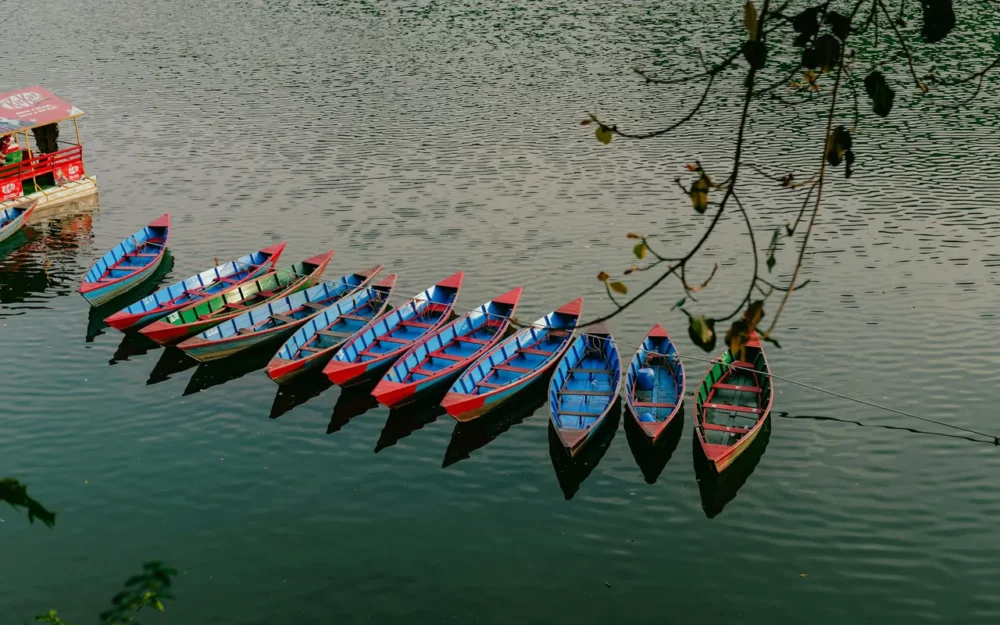
Upon your arrival in Pokhara, a lovely lakeside city surrounded by the Annapurna range, you stay in your hotel. The evening is perfect to spend walking by Phewa Lake or to visit Devi’s Falls and the World Peace Pagoda.

Activity
Drive
Accommodation
Hotel
Meals
Breakfast, Lunch
Max Altitude
822mDay 03: Drive to Birethanti and Trek to Ulleri
Your trek begins from the starting point of Birethanti, after you have breakfast and a short drive from Pokhara. From here you start walking in subtropical forests, riverside trails and amongst the local settlements.
You will go through the villages of Tikhedhunga and Hile taking steep staircases along with them up through lush greenery. The hike on this day is of moderate difficulty, especially on the steep climb towards Ulleri, a Magar village located around 2,070 meters (almost 7,000 ft).
On arrival there are the wide views of the Annapurna South and Himchuli peaks. Teahouse overnight stay at Ulleri.
Activity
Trek
Accommodation
Guest House
Meals
Breakfast, Lunch, DinnerDay 04: Trek to Ghorepani
From Ulleri the path climbs through rhododendrons and oak forest. Along the way, you’ll have views of the snow covered peaks through Banthanti and Nangethanti. Cool, fresh forest path provides an chance to see the Himalayan wildlife and birds.
By the way, after several hours of trekking, you finally get to Ghorepani, a very nice village located at 2,860m. This is a hub for trekkers heading to Poon Hill and the views of the Dhaulagiri and Annapurna are spectacular. After a night at a cozy teahouse, hut or lodge you get ready for an early Poon Hill hike the next morning.
Activity
Trek
Accommodation
Guest House
Meals
Breakfast, Lunch, DinnerDay 05: Hike to Poon Hill and Trek to Tadapani
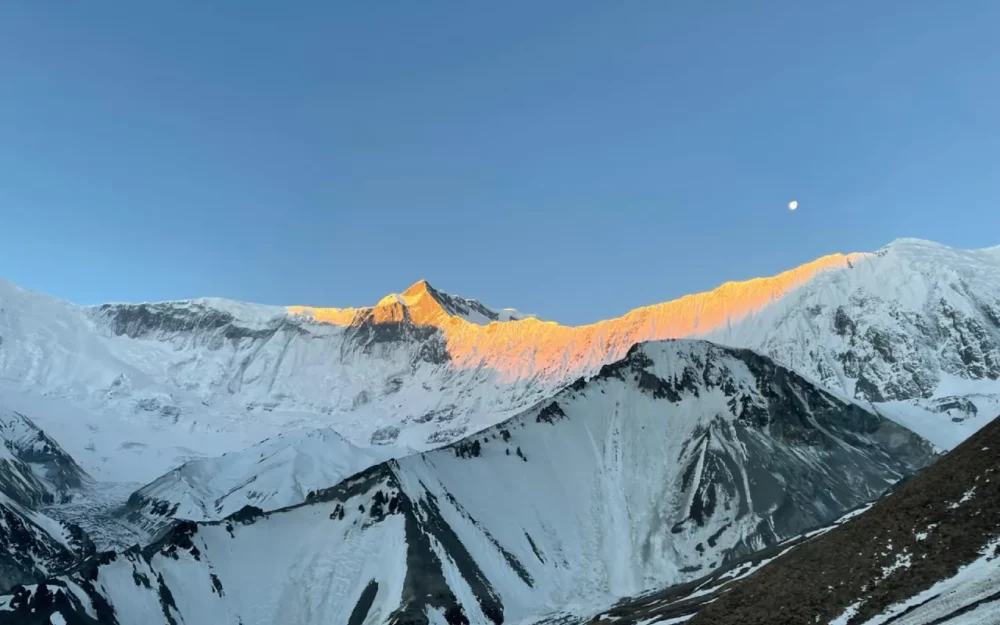
Start your day with an early morning hike to Poon Hill (3,210m), one of the most preferable viewpoints in the Annapurna area. A stunning sunrise over such peaks as Annapurna, Dhaulagiri, and Machhapuchhre awaits you after the pre-dawn ascent.
Descending to Ghorepani enjoy your breakfast after viewing quite a lot. The trail goes onward through dense forests of rhododendrons and small settlements to cross over at Tadapani.
The trail offers enchanting woodland scenery and occasional wildlife sightings. Tadapani (2,630m), a tranquil spot amidst the forest, offers magnificent mountain views and a peaceful resting place for the night.
Activity
Hike
Accommodation
Guest House
Meals
Breakfast, Lunch, DinnerDay 06: Trek to Sinuwa
Descend through lush forests following breakfast and arriving down to the village of Chuile then down to cross a suspension bridge at Kimrong Khola. Chhomrong, a major Gurung village, is from where a steady climb brings you to the village offering splendid views of Annapurna South and Machhapuchhre.
Then you will walk down to Sinuwa (2,340m) through the stone steps and then again up through the forested trail after having lunch in Chhomrong. This segment offers trekker some less noisy trails and fewer tourists. Sinuwa makes an acceptable overnight stop within the forested ridges; the Himalayan grandeur is hinted at.
Activity
Trek
Accommodation
Guest House
Meals
Breakfast, Lunch, DinnerDay 07: Trek to Deurali
Today we venture deeper into the Annapurna Sanctuary. The trail begins departing from Sinuwa through thick stands of bamboo and rhododendron forests. You’ll then go through Bamboo Village (a calm stop in the trees) and then it is a gradual ascent to Dovan and finally to Himalaya Hotel.
When the altitude goes up, vegetation is sparse and air is colder. It ends with climbing past Hinku Cave, with wriggling gorges to negotiate before reaching Deurali (3,200m) a high-altitude campsite with dramatic cliffs and high peaks surrounding it. Ahead of the base camp, Deurali is the point where one crosses into a more alpine set of environs.
Activity
Trek
Accommodation
Guest House
Meals
Breakfast, Lunch, DinnerDay 08: Trek to Annapurna Base Camp (ABC)
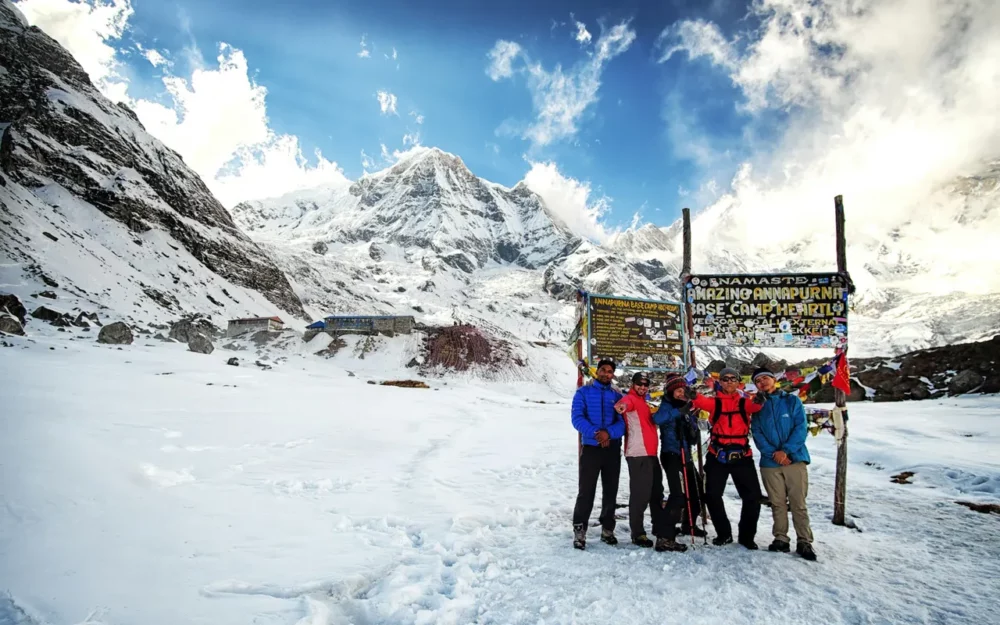
Today is the highlight of the trek. Start early from Deurali and ascend past the Machhapuchhre Base Camp (MBC) at 3,700 meters with a break to admire the breathtaking view of the Holy ‘Fishtail’ peak. A gentler route up from MBC to Annapurna Base Camp (4,130 m) lies via a glacial moraine valley.
Further on in the landscape, the amphitheater widens over an overwhelming natural amphitheater of the Himalayan giants Annapurna I, Annapurna South, and Hiunchuli. You will spend the night immersed in the serenity and majesty of the Himalayas, quite a once in a lifetime experience.
Activity
Trek
Accommodation
Guest House
Meals
Breakfast, Lunch, DinnerDay 09: Trek to Bamboo
After viewing the splendor of Annapurna Base Camp, you’ll start making your descent down the trail back. The route retraces your steps past Machhapuchhre Base Camp and Deurali.
It is easier on the lungs as you go down, nevertheless, descending steep and rocky paths requires caution. From the Himalayan and Dovan, you will pass through to come to Bamboo (2,310m), a small settlement with verdant forests all around.
The overnight stay in this village is quite cool and misty most of the time. You know it is the place where you can rest and reflect on your journey into the heart of the Himalayas.
Activity
Trek
Accommodation
Guest House
Meals
Breakfast, Lunch, DinnerDay 10: Trek to Jhinu Danda
Today, a trek from Bamboo, back through Sinuwa to Chhomrong, is your route of the day. From the familiar ascent to Chhomrong to a hearty lunch and then a steep descent from stone steps to the riverside village of Jhinu Danda (1,780m).
The main thing that makes this place unique are its natural hot springs, you can access springs that are pools located close to the river by a short hike downhill while soaking your tired muscles in warm and mineral-rich water. This is one of the most relaxing stops across the trek due to the combination of serene scenery and rehabilitating waters.
Activity
Trek
Accommodation
Guest House
Meals
Breakfast, Lunch, DinnerDay 11: Trek to Syauli Bazaar and Drive to Pokhara
Last day spent on foot is along the Modi Khola River to charming Gurung villages and terraced fields. It’s a gentler walk with a good view of scenic beauties that comes gradually down to Syauli Bazaar.
After that, you will be driven back to Pokhara by a private vehicle. When you arrive to Pokhara, you’ll be back into civilization with an opportunity to relax at the lakeside, eat sumptuously or take a massage. It is a celebratory day when you have reached the end of your trek and returned to civilization.
Activity
Drive
Accommodation
Hotel
Meals
Breakfast, Lunch
Max Altitude
822mDay 12: Return Drive to Kathmandu
In the morning, you will start the drive back to Kathmandu which is usually 6 to 8 hours by tourist bus or private vehicle. The journey goes through stunning river valleys, hills and small towns and gives one last view of rural Nepal.
You will arrive in Kathmandu and check into your hotel here where you spend your last night of the trip in Kathmandu. You decide to wander around Thamel to find souvenirs, have a farewell dinner with your group or anything else you wish to do and think about how far you have come.
Activity
Drive
Accommodation
Hotel
Meals
Breakfast, LunchDay 13: Final Departure
It is goodbye to Nepal. You are transferred to Tribhuvan International Airport based on your flight schedule. The parting should not occur without the unforgettable memories of majestic peaks, serene trails and the warmth of the Nepalese hospitality.
Home or next adventure home, you will forever be etched with the Annapurna experience. Many are trekkers who swear to return, to return someday to Everest or Langtang or one of the many Himalayan challenges.
Meals
Breakfast
Max Altitude
1350mTrip Information - Good to Know
Best Time for ABC Trek
Annapurna Base Camp Trek can be best done in the spring from March to May and autumn from September to November.
In spring, the days are warm, rhododendron forests bloom and the skies are clear, giving photographers and lure seekers great scrub shots.
The crisp mountain views and stable weather come after the monsoon clears the dust and humidity, even though slight rain falls can occur around the mountains. During these seasons the trekker is guaranteed a good balance of company and solitude.
Winter (December to February) can be a serene and less crowded time, it is snowy and extremely cold. Leaches, slippery trails and obstructed views make monsoon (June to August) the least desirable.
Spring and Autumn are altogether the best Will certainly yield the most comfortable and scenic trekking experience to beginners and experienced hikers alike.
Difficulty and Fitness Level for Annapurna Base Camp Trek
Annapurna Base Camp Trek is classified as moderate difficulty trekking suitable for all trekkers with good fitness levels. Including daily walk 5 to 7 hours that includes ascents and descents as well as stone steps, especially such challenging ones as climbing up to Ulleri or descent to the Jhinu Danda.
There is no technical climbing needed to go here, you just need to be comfortable walking uphill with a backpack for many days straight. While experience working with trekking is useful, it is not necessary.
Key are cardiovascular endurance, leg strength and stamina. It is highly recommended to do pre-trek conditioning by hiking, stair climbing, or aerobic exercises. A big role too is mental determination. The altitude increases steadily, which, however, can still pose challenges even in case of a staged ascent reaching a maximum at ABC (4,130m).
Having a porter is one less physical burden and having a guide helps determine pacing and drives you on. It’s very manageable with preparation and an even pace overall.
Altitude Sickness and Acclimatization
On the Annapurna Base Camp Trek, anyone on the trek is hesitant to avoid altitude sickness, and when the trek heads through Deurali (3,200m) and ABC (4,130m), the probability rises significantly.
Symptoms are common with headache, nausea, dizziness and loss of appetite caused by rapid elevation gain. The ABC trek doesn’t climb so fast as to other Himalayan routes, but an appropriate acclimatization is, of course, required. You need to hydrate heavily.
Eat three to four liters of water. Caffeine and alcohol should be avoided and try to follow ‘climb high, sleep low’ rule. They include resting days, that help your body to adapt. Some can find Diamox (acetazolamide) an option to prevent it, but a doctor would need to be consulted first.
However, in case symptoms worsen, immediate descent has to be made. Trained guides are trained to look for signs and do what needs to be done. Severe altitude sickness is rare on this trek but while you do it, you must respect your body’s limits and stay alert to have a safe and fun trek into the heart of the Annapurna Sanctuary.
Essential Permits for the ABC Trek
Two permits are required for the Annapurna Base Camp trek, a TIMS card (Trekkers’ Information Management System) and an ACAP permit (Annapurna Conservation Area Permit).
The TIMS card serves to ensure trekker safety by registering your details and using them to track you in case of climatic disasters or any kind of emergency, and the ACAP permit aids in the conservation of the Annapurna region and the development of local infrastructure in the area.
Both permits can be obtained from Kathmandu (at the Nepal Tourism Board Office) or Pokhara prior to beginning your trek. TIMS costs NPR 2,000 for independent trekkers and NPR 1,000 for trekkers in a group, whereas foreigners should pay NPR 3,000 for ACAP.
Bring passport-sized photos along with a copy of your passport. You have to carry these permits with you at all times; they’re checked at various points on the route.
If you do not get one, then you could be denied entry to parts of the trail, or fined. It is advisable, always to secure your permits in order to avoid a delay.
Flora and Fauna on the Annapurna Base Camp Trek
The treasury has a rich meet-up of vegetation and its surroundings are rich in both flora and fauna. Low, lush, subtropical forests are rich in ferns, bamboo and orchids at their lower elevations.
The higher you climb, forests of oak and pine turn into alpine shrublands and barren moraine land around the base camp. Normally, trekkers have a chance of sighting langurs, musk deer and Himalayan tahrs.
There are also some rare species to be seen here, such as the red panda and snow leopard, but sightings of those are equally rare. It can be enjoyed by birdwatchers for the species of Himalayan monals, eagles, and sunbirds.
Biodiversity is also ensured to be conserved through the Annapurna Conservation Area, and the journey immerses the participants in the natural experience vividly.
Cultural Experience during the ABC Trek
The Annapurna Base camp trek is not only in vivid scenery over breathtaking scenery but it is an all-complete travel in culture. Throughout your trip, you are going to pass through Gurung and Magar community villages such as Ghandruk, Chhomrong and Ulleri etc, where people are famous for their hospitality and different cultures.
The trail has colorful stone houses, prayer flags and Buddhist chortens as evidence of their deep-rooted spiritual beliefs. Most locals are outgoing citizens, probably former or active Gurkha soldiers, and their inherent resilience results in people who are quite warm and welcoming with their teahouses.
Using the local dialect and many forms of traditional food, its cultural interaction can even be brought to life by a folk dance or music performance at times.
The trek is spiritually deepened by visiting monasteries and observing the religious practices. These interactions are improved by learning basic Nepali greetings such as ‘Namaste’. The Annapurna Base Camp Trek as a whole is an exquisite immersion into Himalayan life along with its timeless cultural richness.
Food and Accommodation Along the Route
The Annapurna Base Camp trek is mostly offered through teahouses which are simple, family houses and in these teahouses, people are served meals and accommodation. Nepali dal bhat (lentils, rice, vegetables), momos, noodles, pasta, soups and occasional Western meals such as pancakes and toast are typical meals.
At teahouses, snacks, tea and bottled water can also be bought, but prices go up with altitude. There are simple twin bedrooms with shared bathrooms and beddings of warm blankets. At higher elevations amenities are limited and there may be an extra charge for heating.
Some stops provide Wi-Fi, hot showers, and device charging for a small fee. Some teahouses are not luxurious but they are nice and cosy along with a good communal trekking experience.
For availability in peak seasons, it is advised to book early. It is rustic but it is a fulfilling experience of Himalayan hospitality.
Travel Insurance for Annapurna Base Camp Trek
Being a remote trek, going to high altitudes with unpredictable weather, travel insurance is essential for the Annapurna Base Camp trek. ABC is at 4,130m, so policies should include high-altitude trekking coverage to the altitude of 5,000m.
Access to hospitals is limited in the area, so it is advisable for your plan to cover for emergency medical evacuation generally done by helicopter. Besides that, there should be medical coverage, trip cancellation, lost luggage, and delayed flight coverage as this is common while in mountain regions.
Make sure ‘trekking’ is not going to be one of the items excluded from the ‘adventure sports’. Popular providers like World Nomads, Allianz, or SafetyWing offer trek-specific packages. Carry your insurance on you (digital and printed) and also forward details to your guide.
A rescue can cost thousands of dollars upfront and without the proper insurance. You simply haven’t had enough experience with such incidents to realize how quickly everything can change. It’s a small investment for peace of mind, and you’re protected in the event of the or really, any other unforeseen incidents that can occur on the trail.
Frequently Asked Questions
What kind of power options are available during the ABC trek?
Generally, phones and batteries can be charged in most teahouses’ charging facilities, which are based on either solar or generator. At higher altitudes the charges may come with small fees, so bring a power bank.
How cold does it get on the Annapurna Base Camp Trek?
Annapurna Base Camp Trek an have temperatures dropping to as low as -10°C to -14°C (as low as 14°F) from November to March. Although warm layers and a good sleeping bag are necessary for any trek to these parts, the lower elevations are milder.
Can I use my phone on the Annapurna Base Camp trek, and what’s the network coverage like?
Mobile coverage is weak. Some villages do have service from NTC and Ncell but on the network up high, the signal is weak. In some teahouses, especially on lower areas, there is Wi Fi for a fee.
Are there any ATMs or card payment options on the Annapurna Base Camp trek?
After the trek starts there are no ATMs or dependable card payment choices. Nepalese Rupees (cash) will be needed to pay for food, lodging, and extras. If possible, withdraw enough before the trek in Pokhara or Kathmandu.
What kind of gear is available for rent in Kathmandu or Pokhara?
Basically, you can rent almost any trekking essentials like down jackets, sleeping bags, trekking poles, backpacks, crampons, and so forth. The chances are that the prices are quite all right, and you should be able to find gear in local rental stores as well as in branded shops in both Thamel and Lakeside.
Do I need a guide or porter for the Annapurna Base Camp trek?
A hiring a guide isn’t mandatory, nevertheless, it assures safety, navigation and cultural insight. Carrying a heavy load of gear drains much energy and breaks the mind that porters help to wean off. Both of them are highly recommended for beginners or solo trekkers in off-season or off-the-beaten-track.
Trip Reviews
 Write a Review
1350 US$
Group Discount Price
-
1 -
1 person
US$ 1400
-
2 -
5 people
US$ 1350
-
6 -
10 people
US$ 1300
-
11 -
16 people
US$ 1300
-
17 + people
9999
US$ 1300
Total Cost:
US$ 1400


How to book a trip?

make free inquiry

